
Writer’s Note
This piece is part memory, part feeling, and part search. It is not a linear story. It moves like memory does; fragmented, circular, sometimes clear and sometimes smudged.
I wrote this not because I have answers but because I needed space for the questions, a space where my vulnerability could be acknowledged and understood. It took courage to share these experiences, and I hope it inspires you to recognise your vulnerability.
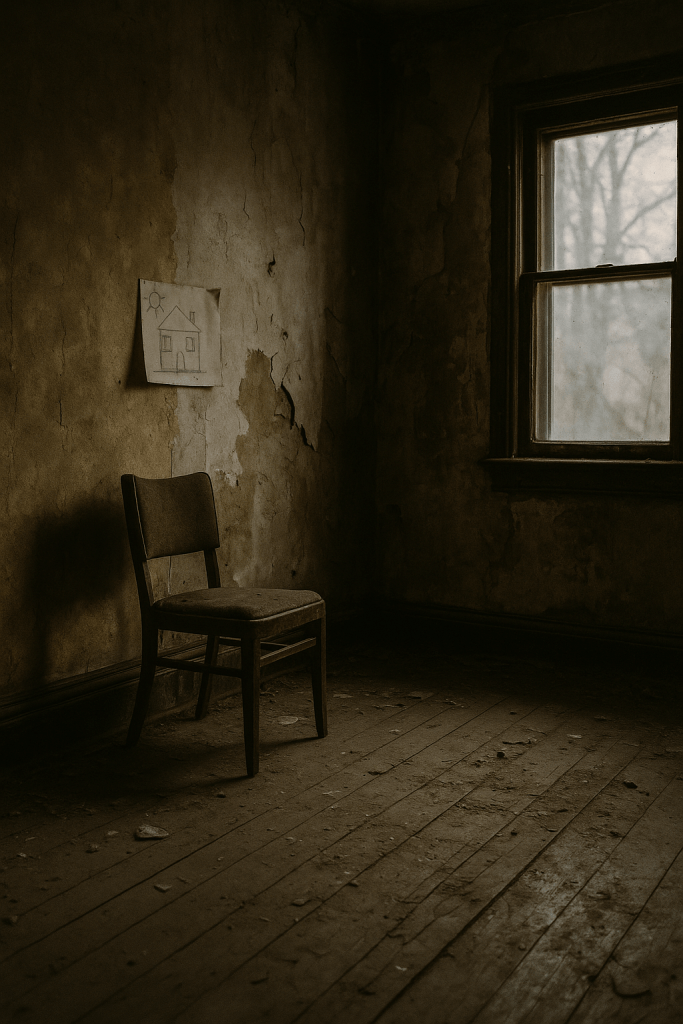
Still Living in That House reflects on growing up in emotional and physical ruins, what it means to carry your childhood into adulthood, and how survival can sometimes feel like an unfinished sentence.
It is about the trauma that lingers, homes that never became home, and the quiet ache of trying to belong to yourself after being shaped by spaces that make you feel unworthy.
Some of what you’ll read may come as a surprise, some might be difficult, and some might resonate more than expected. As we navigate through the spaces that almost ruined me, my only hope is that, if you find yourself anywhere in these words, you can walk with me through this shared journey of finishing this house and becoming finished. And, in turn, you become finished, too.
This story is Part One. The house isn’t finished.
Neither am I.
— Shantey Moabelo
A Memoir of Unfinished Journeys
I spent my childhood moving through fragments; half-buried memories, like dusty foundations of an unfinished house; a metaphor for the instability and uncertainty that characterised my early years. Like my life, the house was a work in progress, never quite complete.
The first fragment is stubbornly bright. We lived in a cramped one-bedroom apartment in Kwaggafontein, Mpumalanga. I was a small child. Someone else watched me after school. I remember her asking, “What’s your African name?” I didn’t know. I ran to Mom. She whispered a name into my ear; something she came up with on the spot, I think, and I brought it back proudly. Then, in an instant, that moment just stopped like a page torn mid-sentence.
Then there’s this other flicker. I’m learning to walk, holding onto two-litre Coke bottles like they’re crutches. I don’t know if it’s my mom I’m walking toward or my sister. All I remember is the joy, how light the air felt in that second, how warm the sun felt that day, how proud I was and how proud they were. It was brief. And then it was gone.
Another memory: waking up to my mother packing everything. I don’t know what day it was. I don’t even think I was old enough to understand what moving meant. She said we were going to Pretoria, and that was it. No explanation, no goodbye to my friends, no final walk through the classroom.
I was just starting to feel safe.
There was a girl, Charmaine. Or at least, I think her name was Charmaine. Perhaps I made up the name so I could remember her. She was my first friend, a bright spot amid the turbulence of my childhood. I don’t remember her face; only the feeling of her presence when we played “Diketo” during break, the presence of someone who mattered, even if only for a short time.
Like so many chapters of my life, Charmaine’s story ended abruptly without the closure I desperately craved. The absence of closure and the unanswered questions cast long shadows, a constant reminder of what could have been, a reminder that I long for resolution.
We moved to Pretoria. It was my birthday. Someone, Mom or Sister, asked what I wanted. I said McDonald’s. I’d never had it before, but I’d probably just seen it on our old TV. But they got it for me. I remember the Happy Meal, the toy. I remember smiling. We lived in a wooden shack, which I called a house, even though it was just a wooden structure and our dreams. I didn’t feel poor. I didn’t know what “better” looked like.
The shack was next to something new: a foundation. My mother had started building a house before we moved to Pretoria. It was just a concrete slab at the time, but it was hope in the shape of a beginning. Several years later, we lived in the house, or what would one day become a house. There was always dust on everything. It was hollow, half-finished, and cold. The unfinished state of the house mirrored the uncertainty and instability I felt in my own life, a constant reminder of the work that was left undone and the dreams that were yet to be realised.
One day, my mom went outside and started digging in the yard, pulling weeds, clearing space, and working the ground like a battle she had to win. She played the same sad song on repeat. I wish I could remember the name. It was a song that encapsulated her struggles and the pain she carried. When we tried to stop or change it, she snapped. She told us to leave it alone and to keep playing it. She didn’t talk to any of us that day. I remember being confused and afraid, wondering if I had done something wrong or if we had done something wrong. I tried to understand the silence and why this song had become a wall between us.
We lived in that half-built house for a long time. My mom never finished it, not while I lived there, and many years after I left, it still remains unfinished. The foundation was solid, but everything else was patchwork. The rooms had nothing but an idea; we had covered the windows in newspapers, and the air always smelled like cement and dust.
Years later, I find myself emotionally tethered to that half-built house. The echoes of the past resonate within me, hindering my ability to fully embrace the present.
I’m still waking up in a mess, wondering when things will finally come together, remembering the names of people who once made me feel safe, and asking myself if I did something wrong. The child who learnt to walk with Coke bottles, smiled over a Happy Meal, and whispered made-up names to feel known, that child still lives in me. And now, she also lives with sinusitis.
Perhaps the most challenging aspect of my journey is the persistent feeling of being a work in progress. I long for the day when someone will say, ‘It’s finished now. You can rest.’
And then I remember high school. Honestly, I don’t know what started the argument between my mom and me. Most of that day is a blur. But there’s one thing I remember like it just happened; like the sentence etched itself into the walls of my memory.
I had asthma growing up. I was in and out of hospitals almost every year of primary school. My lungs were fragile. Crying too much would make me lose my breath, gasping for air, like my own body was turning against me. And during that fight, when I was crying and gasping again like I used to, my mom looked at me and said,
”Le ge e ka go tšea, re tlo kgona go go boloka.”
“It’s okay if it takes you. We’ll be able to bury you.”
Darkness.
I don’t remember anything after that. But I remember those words.
I remember crying.
I remember my sister comforting me.
I remember silence.
And then the image fades.
Another memory takes its place; a house infested with cockroaches. They were everywhere. I had to teach myself not to scream when I saw one. I had to learn how to live in the presence of things that made my skin crawl. To this day, I can’t stand insects. I can’t even kill them. I freeze. Back then, I’d look away and pretend they weren’t there.
The house was falling apart.
There were rats, too.
Dead walls. Broken cupboards. Things that made me feel unsafe, even in my own home.
It was a house no one was meant to grow in.
But I did, though not entirely.
Sometime in the middle of high school, something shifted. I started to feel things I didn’t know how to put into words. I started liking someone, a boy who occasionally visited family nearby. He was sweet, my age, and for a moment, I got to feel what a crush was supposed to feel like.
On Valentine’s Day, he gave me a rose. I didn’t even know where to hide it. I was nervous, excited, and afraid my mom would find it.
He held my hand that day.
And I held his.
The person my mom was seeing at the time saw us and told her.
I liked to jog back then; my sister and I would run together. But she had gone to varsity, so I jogged alone. I was jogging that day when the fragments of my existence changed, again. My mom thought I went to meet the boy. I hadn’t, but she didn’t believe me.
She told me to get out of her house.
Told me to go back where I came from.
”Ke be ke ile go kitima, Mama“,
I said to her.
“I was just jogging, Mom.”
But she picked up a shovel and hit me with it.
And told me again to leave.
So I did.
I left.
I sat outside the house, overlooking the gate, staring at the road ahead.
I used to sit in the same spot as a child, playing with a Bratz doll, waiting, and hoping my father would come.
He never did.
But I’d sit there anyway.
Alone.
Hopeful.
Talking to myself.
That may be why I started making things up.
Maybe I did make up the name Charmaine.
So that someone could be real, even if they weren’t.
That day, after the shovel, after she asked for the gate key, I left for real and went to a friend’s house.
That was the first time I got drunk. The first time, I didn’t care what happened to me.
If I lived or died, it didn’t matter.
That day, something in me shut down, and I started dancing with the idea of death.
I’m an adult now.
When I moved away for varsity in 2016, I experienced something I’d never had before.
My room.
My bed.
My own space.
It was the first time I had ever slept alone; my mom, sister, and I always shared the same bed.
All of us, in one space. Copped up in a small bed.
Even now, when I go home, though I haven’t been home in a while, we still sleep in the same bed.
With the light on.
Always, the light was on.
And I hated it. I couldn’t sleep.
The brightness, the constant humming of the TV, the noise…
My mom always slept with the TV on.
Now, I can’t sleep unless everything is off.
Every light. Every sound.
I’m up all night if there’s even a flicker of brightness in the room, or a whisper of sound.
Wide awake.
Restless.
My body doesn’t know how to rest unless it’s silent and dark.
I crave the opposite now because of how I grew up.
Maybe silence feels like safety now. Perhaps the darkness means I’m finally alone.
Having my own space has been amazing. My room has become a sacred place. Something that’s mine. Something I can close the door to and say,
“This belongs to me.”
And yet, even here, even in my own space,
I’m still living in that house.
This sacred room of mine is still messy.
I try to keep it clean. I try harder now.
But it’s almost always a mess.
No matter how many times I tidy up, the mess returns.
Just like the memories.
Just like the feelings.
Just like the things I thought I left behind.
I still live in that house.
In the clutter.
In the chaos.
In the noise that shaped me, even though I now demand silence.
I’ve tried to run from it, to shut the door, to pack things away neatly,
But it’s like the mess follows me.
Or maybe, it now lives inside me.
I tried a few times to kill myself. But even then, I knew; it wasn’t because I wanted to die. I just wanted to switch off. I wanted everything to stop. The feelings were too much. I didn’t want to feel them. I wanted to learn how not to feel anything in the moment, even if it meant forever.
Because feelings, to me, feel real. Too real. I don’t just feel sad. I live inside the sadness. I don’t just feel fear. I move through the world as if the fear is air.
And I hated that. I hated how loud everything was inside me.
The most vivid attempt was the last one. Something had happened, I still don’t even know what to name the feeling, but I couldn’t take it. The emotional burden, the pain, the physical weight of feeling too much; it was like my whole body was drowning in it.
So I went home, locked the door, and left the key in it. I took every sleeping pill I could find, mixing the pills with things I shouldn’t have combined them with.
I got into bed.
And I waited.
It didn’t take long for the darkness to come; a blackness without edges.
No sound. No thought. No dream. No emotion.
It was everything I’d wanted.
Complete silence. Complete stillness. Complete Darkness.
Everything stopped. And I wasn’t afraid for the first time in a long time.
It didn’t feel scary. It felt peaceful. Right.
Maybe death wasn’t so terrible after all.
Sometimes, I wish that silence had lasted forever.
But it didn’t.
A friend found me unconscious and called the ambulance. Doctors saved me.
And I lived.
I’m grateful for them. I am.
But sometimes, I wish they hadn’t.
I hate having to live sometimes. I hate that I lived in that house. And I hate that I still live in it.
I hate that I chase darkness more than I chase light. That I seek silence more than laughter and the beautiful noise of life as it is.
I hate that I still feel the dirt on my skin like it’s part of me. Others can see it, too. Perhaps that’s why I struggle to maintain relationships. Maybe that’s why I avoid them. Because I think if people get too close, they’ll see me. The real me. The unfinished house. The mess.
Maybe that’s why I’m avoidant; why I developed an avoidant attachment. And I hate that, too.
I hate that sometimes; I hate myself so deeply. And sometimes, I love myself so much that it scares me. I hate that there’s never a middle ground.
I hate chasing after beauty when I’m unsure what it looks like. I hate not knowing what things should feel like. I hate doubting happiness when it shows up at my door; I don’t trust it enough to let it in.
Everything feels like a contradiction. Like chaos wrapped in skin. I am either the best version of me, or I am crumbling, never in between.
But even in that mess, I know I’ve gotten better.
I do chase something now. I chase the ocean. I chase music; I love music, especially Jazz. I love how the instruments come together, as if they were always meant to find each other. I love the noise it brings, the harmony, and the deliberate disorder that still somehow makes sense.
I love the sunset. I love the sunrise.
Those quiet transitions remind me that maybe light isn’t so bad, especially when it knows how to soften into darkness.
I don’t know if it gets better. I don’t know what healing looks like. I don’t know if I will ever be able to sit in the in-between; the healthy place, the finished house.
But I keep asking myself one thing:
Does she ever finish building that house?
And if she does,
Will I become finished,
Too?
 Unfinished Rooms